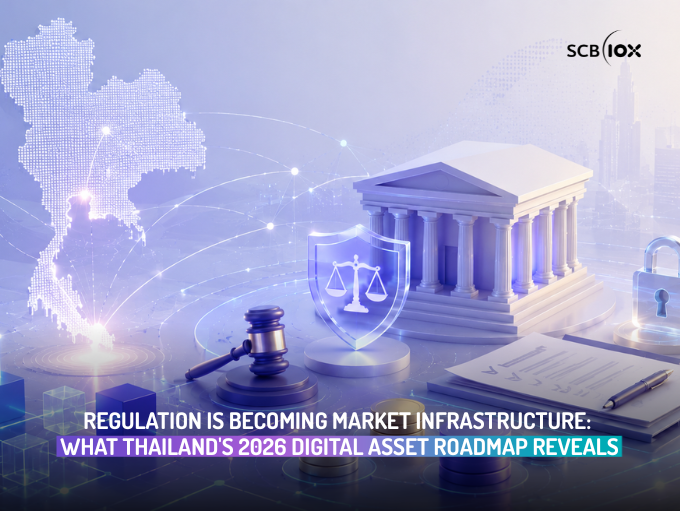

The New Rulebook Is a Growth Engine: How Regulation Is Becoming Market Infrastructure
.jpg)
The promise of stablecoins is borderless money. The reality is that every jurisdiction is building a different fence around it. Singapore's rules, Hong Kong's rules, Japan's rules, Thailand's rules — each creates a separate compliance surface. The question is whether that produces a coherent global market or a patchwork that entrenches local incumbents and prices out smaller players. That is the regulatory story worth telling in 2026 — not whether digital assets are permitted, but whether the rules being written will produce competition or fragmentation.
In other words, regulation is becoming a growth engine. The jurisdictions that design effective frameworks may become the jurisdictions that attract the next generation of financial innovation.
Regulation Is Moving From Gatekeeper to Market Builder
The first phase of digital asset regulation focused primarily on risk containment.
Governments sought to understand new technologies, limit consumer harm, and establish legal boundaries around activities that often emerged faster than existing frameworks could adapt.
Today, the conversation is becoming more strategic.
Policymakers increasingly recognize that digital assets are not simply new investment products. They represent a new layer of financial infrastructure with implications for payments, capital formation, asset management, and market efficiency.
As June Lau, Head of APAC Policy & Regulatory Affairs at Elliptic, observed: "The debate is no longer 'should digital assets be allowed?' Digital assets are now central, not peripheral, to how regulators think about capital markets."
Rather than merely supervising markets, regulators are increasingly helping shape them.
Thailand Offers a Case Study in Market Design
One of the clearest examples of this trend is Thailand.
The Securities and Exchange Commission's 2026–2028 roadmap outlines a coordinated strategy focused on:
- Digital securities ecosystem development
- Real-world asset tokenization
- Crypto as an investment asset class
- Technology-driven supervision
- Enhanced fraud prevention and cybersecurity
Taken individually, none of these initiatives appear transformative. Taken together, they represent something more significant. They form the foundations of a digital capital market architecture.
A major milestone is the launch of Thailand's Digital Securities Ecosystem (DSE) initiative, designed to support tokenized securities issuance, distribution, and market infrastructure.
The regulator is also advancing common standards intended to improve interoperability across tokenization platforms and market participants.
This matters because fragmented infrastructure creates fragmented markets.
Common standards create scale.
The Market Is Already Moving Through the Framework
Perhaps the strongest signal that policy is influencing market development is that activity is already emerging inside the regulatory structure.
According to Thailand's SEC, more than US$263 million has already been raised through approved investment-token offerings spanning real estate, sustainability initiatives, infrastructure projects, entertainment financing, and other alternative asset categories.
- The figure remains small relative to traditional capital markets.
- However, it demonstrates an important principle.
- Capital is already moving through the framework.
- Regulation is no longer preparing for a future market.
- It is increasingly shaping a live one.
- Another signal comes from institutional participation.
Currently, six market participants are actively exploring tokenized mutual funds and tokenized bond issuance under Thailand's regulatory framework. Again, the number itself is modest.
The significance lies in what it represents.
Institutions are investing resources, operational effort, and regulatory engagement because they believe a viable market pathway exists. That confidence is often impossible without regulatory clarity.
Product Architecture Is Becoming Regulatory Architecture
One of the most interesting developments across Asia is the growing convergence between policy design and product design.
Historically, regulators focused on supervising products after they reached market.
Increasingly, regulation is influencing how products are built from the outset.
This can be seen across multiple areas:
Crypto ETFs
Thailand is evaluating frameworks that could support regulated crypto ETF products, expanding investor access while maintaining familiar market structures.
Tokenized Securities
New rules are being developed to accommodate tokenized bonds, tokenized funds, and digital securities while preserving investor protection standards.
Stablecoin Frameworks
Jurisdictions including Singapore, Hong Kong, Japan, and Thailand are building rules that support stablecoin issuance, reserve management, and operational oversight.
Travel Rule Compliance
Cross-border transaction requirements are increasingly becoming part of digital asset infrastructure rather than an afterthought.
Interoperability Standards
Common standards are being developed to ensure tokenized assets can move between platforms, issuers, and financial institutions without creating isolated ecosystems.
These initiatives highlight a broader trend. Regulation is becoming increasingly intertwined with market architecture.
The Challenge Is No Longer Global Technology. It Is Local Market Design.
One recurring theme throughout discussions on stablecoins and digital asset infrastructure is that global technologies still operate within local regulatory environments.
As Yvonne Ng Vice President APAC of Elliptic noted: "Global stablecoins may be designed for borderless use, but adoption in Asia is shaped by highly local realities."
This tension will likely define the next phase of market development. Stablecoins may settle globally. Tokenized assets may move across blockchain networks. Digital wallets may operate continuously.
Yet every one of these activities ultimately intersects with local laws, local compliance requirements, local tax treatment, and local financial infrastructure.
The result is a new competitive dynamic. Countries are no longer simply deciding whether to permit digital assets. They are deciding how attractive their markets will be for issuers, investors, financial institutions, and infrastructure providers.
Regulatory Clarity Is Becoming a Competitive Advantage
Several discussions throughout the event converged on a similar conclusion. Institutional adoption accelerates when regulatory uncertainty declines.
This was evident across conversations involving stablecoins, tokenized assets, institutional trading, digital custody, and capital markets infrastructure.
The reason is straightforward. Institutions require:
- Legal certainty
- Compliance clarity
- Defined operating requirements
- Governance standards
- Risk management frameworks
Without these foundations, adoption remains limited regardless of technological capability. With them, institutions can begin allocating capital, launching products, and building long-term strategies.
As Chengyi Ong Director of APAC Policy & Regulatory Strategy of Circle emphasized: "We need to look at the outcomes and not just the outputs."
The objective is not regulation for its own sake. The objective is creating markets that are safer, more efficient, and more capable of supporting innovation at scale.
Outlook
The next chapter of digital asset growth may depend less on technology than on market design.
Blockchain infrastructure is becoming increasingly mature. Stablecoins continue gaining traction. Tokenized assets are entering mainstream financial discussions. Institutional participation is steadily increasing. The remaining challenge is creating environments where these innovations can scale responsibly.
That responsibility increasingly falls to regulators. The most successful digital asset markets may not be those with the fewest rules. They may be the ones with the clearest rules, the strongest infrastructure, and the most effective balance between innovation and investor protection.
Regulation is no longer simply a permission layer. It is becoming a competitive advantage. And in the next generation of digital finance, it may prove to be one of the most important forms of infrastructure of all.
Discover more insight at https://youtube.com/playlist?list=PLJCrobWNqQvsuUikHX-4M9PEUpL5uxikm&si=GXEP2ufaJl9va6wQ
YOU MAY ALSO LIKE